Florida Assisted Living Licensing Explained: A Guide for Naples Families
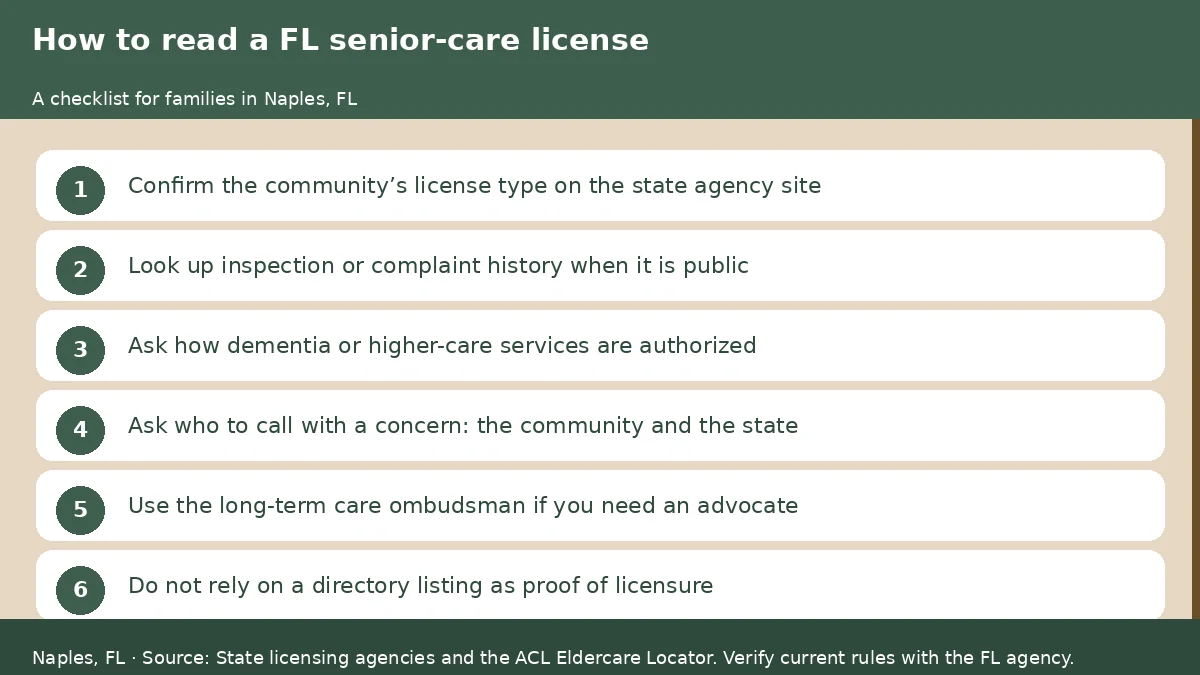
Every assisted living facility in Naples, from a small home on a quiet street to a large community near the Gulf, operates under a license from the Florida Agency for Health Care Administration. The type of license a facility holds shapes what care it can provide and how long a resident can stay as needs change. Understanding Florida's license types, and where to find a facility's inspection record, helps you choose with confidence and ask better questions.
Who regulates assisted living in Florida
AHCA licenses and regulates Florida's health facilities, including assisted living facilities (ALFs). According to AHCA's consumer guide, ALF licensing is governed by Chapter 429 of the Florida Statutes, sections 429.01 through 429.54, and by Florida Administrative Code Chapter 59A-36, which provides detailed rules for licensure and operations (AHCA, Assisted Living in Florida guide, PDF).
AHCA describes ALFs as licensed communities that provide care and housing for adults who need daily support but do not require 24-hour nursing care. Residents typically are 18 or older, need help with daily activities and medications, and may need routine nursing or mental health services, but not 24-hour skilled nursing care.
The four license types
Standard License
Every ALF in Florida must have a Standard License. With it, a facility can help residents with daily activities such as bathing, dressing, and eating; provide or supervise medication use; and offer meals, housing, and general supervision.
Extended Congregate Care (ECC)
An ECC license allows residents to stay longer as their needs increase, rather than moving to a nursing home. AHCA calls this helping residents "age in place." In addition to standard services, ECC facilities may:
- Provide total assistance with bathing, dressing, grooming, and toileting
- Perform limited nursing services and regular health assessments
- Monitor vital signs, weight, nutrition, and fluid intake
- Supervise residents with dementia or cognitive impairments
- Offer or coordinate rehabilitation and escort services
Limited Nursing Services (LNS)
An LNS license lets a facility provide certain nursing care through licensed nurses, such as medication injections, wound care, or monitoring chronic conditions. It does not permit 24-hour skilled nursing care, and residents must still meet the criteria for living in an ALF.
Limited Mental Health (LMH)
An LMH license is required for facilities serving one or more residents who receive state mental health case management. These facilities work with each resident's case manager on a Community Living Support Plan.
Why the license matters
The license tells you what happens as your parent's needs change. A facility with only a Standard License may not be able to keep a resident who needs extensive hands-on help or nursing care. An ECC facility may be able to support a resident longer. When you visit, ask:
- Which licenses do you hold?
- What would happen if my parent needed more care than your license allows?
- Can residents receive outside home health services here?
AHCA notes that residents may receive home care services, such as nursing, through a licensed outside provider, if allowed by the facility and as long as they still meet its residency criteria.
Special care for Alzheimer's disease
Florida law sets standards for any ALF that advertises special care for people with Alzheimer's disease or related disorders. Under section 429.178, Florida Statutes, such a facility must have an awake staff member on duty at all hours if it has 17 or more residents (or, with fewer than 17 residents, either awake staff or mechanisms to monitor and ensure residents' safety), offer activities designed for cognitively impaired residents, provide a safe physical environment, and employ staff who complete required dementia training and continuing education (Florida Statutes, s. 429.178). See our article on assisted living versus memory care in Naples.
Emergency power
Florida rule 59A-36.025 requires every ALF to plan for and maintain an alternate power source sufficient to keep ambient temperatures at or below 81 degrees Fahrenheit for at least 96 hours after primary power is lost, in an area large enough to keep residents safe (Fla. Admin. Code R. 59A-36.025). In Collier County, this is a key question to ask; our guide to hurricane questions for Naples assisted living covers it in depth.
Contracts and rate increases
AHCA's guide says every resident signs a contract or residency agreement that outlines housing and included services, optional services and fees, discharge and refund policies, bed-hold policies, and any special care plans. A facility must give at least 30 days' written notice before a rate increase. Ask for a copy of the contract in advance and review it carefully.
Checking a facility's record
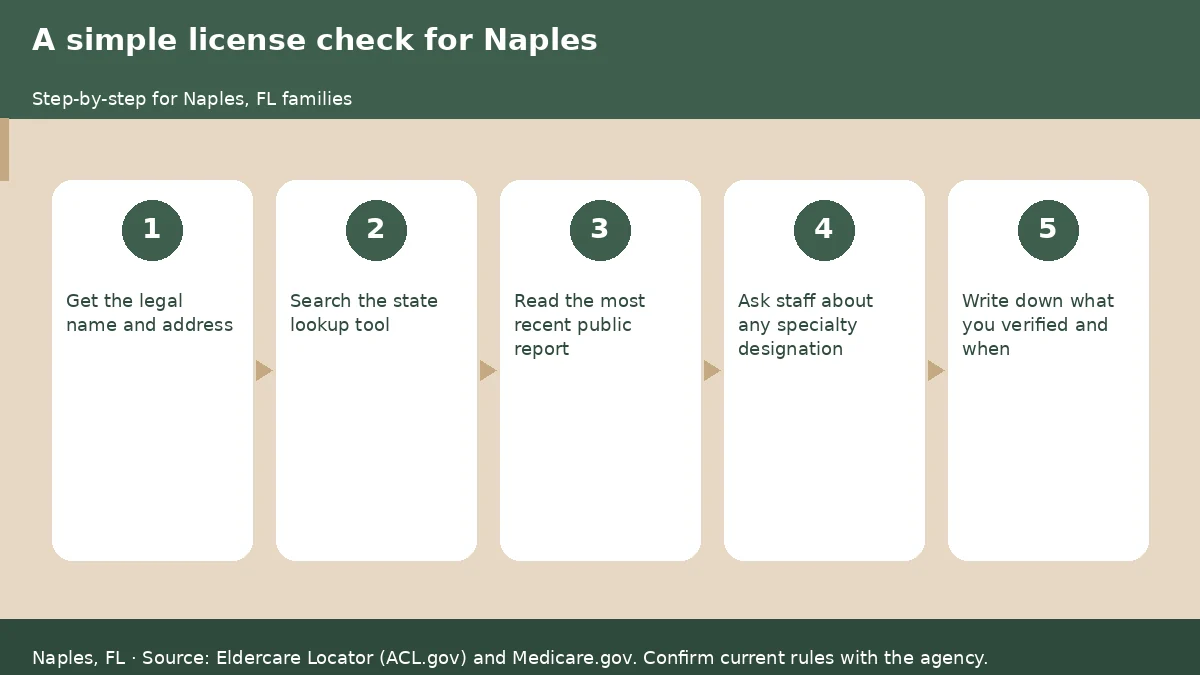
AHCA's FloridaHealthFinder.gov lets families search for licensed facilities, view license type, Medicaid eligibility, and inspection reports, and compare facilities by services, bed size, payment types, and inspection history. AHCA says these tools are updated nightly.
When reading inspection reports:
- Note the date and seriousness of each finding
- Look for repeated problems
- See how and when issues were corrected
- Ask the facility to explain anything that concerns you
A single minor finding is not unusual. Repeated or serious findings deserve a direct conversation.
Other licensed options
AHCA's guide also describes adult family care homes, licensed private homes where up to five adults live together under the care of the homeowner, and adult day care centers, which provide daytime care and supervision. These can be alternatives or complements to assisted living.
Where to raise concerns
- AHCA complaints: (888) 419-3456, or the AHCA complaint form, according to the guide.
- Florida Long-Term Care Ombudsman Program: advocates for residents of ALFs and nursing homes, (888) 831-0404 (Florida Long-Term Care Ombudsman Program).
- Florida Abuse Hotline: to report suspected abuse, neglect, or exploitation, (800) 962-2873 (Florida Department of Children and Families, Abuse Hotline).
- Immediate danger: call 911.
Questions to ask about licensing
- Which AHCA licenses do you hold?
- What did your most recent inspection find, and how did you respond?
- Do you advertise Alzheimer's special care, and how do you meet section 429.178?
- How do you meet the emergency power rule?
- When would a resident need to move?
Talk with Bear Country Living
Bear Country Living is a residential home at 360 37th Avenue NE in Naples offering assisted living and memory care support. We encourage families to look up any facility they are considering. Call (239) 467-6054 with questions and to confirm current availability, or read our FAQ.
Frequently asked questions
What license does an assisted living facility need in Florida?
Every ALF must hold a Standard License from AHCA. Some also hold Extended Congregate Care, Limited Nursing Services, or Limited Mental Health licenses.
What does an ECC license mean?
Extended Congregate Care lets residents age in place, with total assistance with personal care, limited nursing services, and supervision of residents with dementia.
Can Florida assisted living provide nursing care?
Facilities with an LNS or ECC license can provide limited nursing services, but not 24-hour skilled nursing care.
Where can I check a Florida facility's inspection reports?
On FloridaHealthFinder.gov, which shows license types and inspection reports for licensed facilities.